Picking a product is the single decision that decides whether an ecommerce store works. Most stores don't fail on ads or branding, they fail because the product was never going to sell. Good product research tools shrink that risk by showing you what is already selling, who is selling it, and how hard they are spending to keep it alive.
The best product research tools for ecommerce in 2026 are the ones that surface demand you can verify, not just inspiration. WhatWins leads because it pairs ad-spy with organic viral tracking and a Shop Tracker that reveals the actual stores and products behind winning ads. Minea, Sell The Trend, PiPiADS, Dropispy, AdSpy, Peeksta, Shophunter, EcomHunt, and Koala Inspector each cover a useful slice of that picture. If you want the product page first, start with the WhatWins product research tool or the Shopify store spy workflow. If you are already weighing Minea, read Minea alternatives or WhatWins vs Minea.
What a product research tool is actually for
A product research tool exists to answer one question with evidence: is there real, paying demand for this product right now? Everything else, themes, suppliers, pricing, is downstream of that answer.
The strongest signal of demand is money already changing hands. A competitor running the same ad creative for weeks is not doing it for fun; they are doing it because the ad is profitable. A product appearing across dozens of stores is not a coincidence; it's a market that's been validated by other people's budgets. The right tool turns those signals into a shortlist you can act on instead of a feed you scroll.
The wrong tool just gives you more inspiration. Inspiration is cheap. What you want is proof, a long-running ad, a store scaling its spend, an organic post breaking out past its creator's normal reach. Those are the things that separate a product that looks good from a product that is good.
How to choose a product research tool
Before comparing tools, decide what you actually need them to do. The criteria below matter far more than the size of an ad database.
- Proof of demand, not just ideas. Can the tool show you ad longevity, store growth, or organic breakouts, or does it only show you a gallery of products?
- Ad coverage. Does it pull from Meta (Facebook + Instagram) and TikTok? Single-platform tools miss half the market.
- Organic intelligence. Paid ads tell you what's being pushed. Viral organic posts tell you what people actually want to share. The best research uses both.
- The store behind the product. Finding a winning ad is step one. Finding the store selling it, and seeing its traffic, ad load, and estimated spend, is what lets you reverse-engineer the offer.
- Speed and freshness. Trends move in days. Stale data is worse than no data because it sends you after products that already peaked.
- Workflow fit. Can you save, organize, and share findings with your team without exporting to a spreadsheet?
- Price vs. value. A cheap tool that only inspires costs more than a fairly priced one that validates.
Keep these in mind as you read, the right pick depends on which of them you weight most heavily.
The best product research tools for ecommerce in 2026
Below are nine tools worth knowing, starting with the one we build. Each entry covers who it's best for, where it's strong, and where it falls short, so you can match the tool to your situation honestly.
1. WhatWins
Best for: Ecommerce operators and brands who want to find proven products and reverse-engineer the stores selling them, in one tool instead of five.
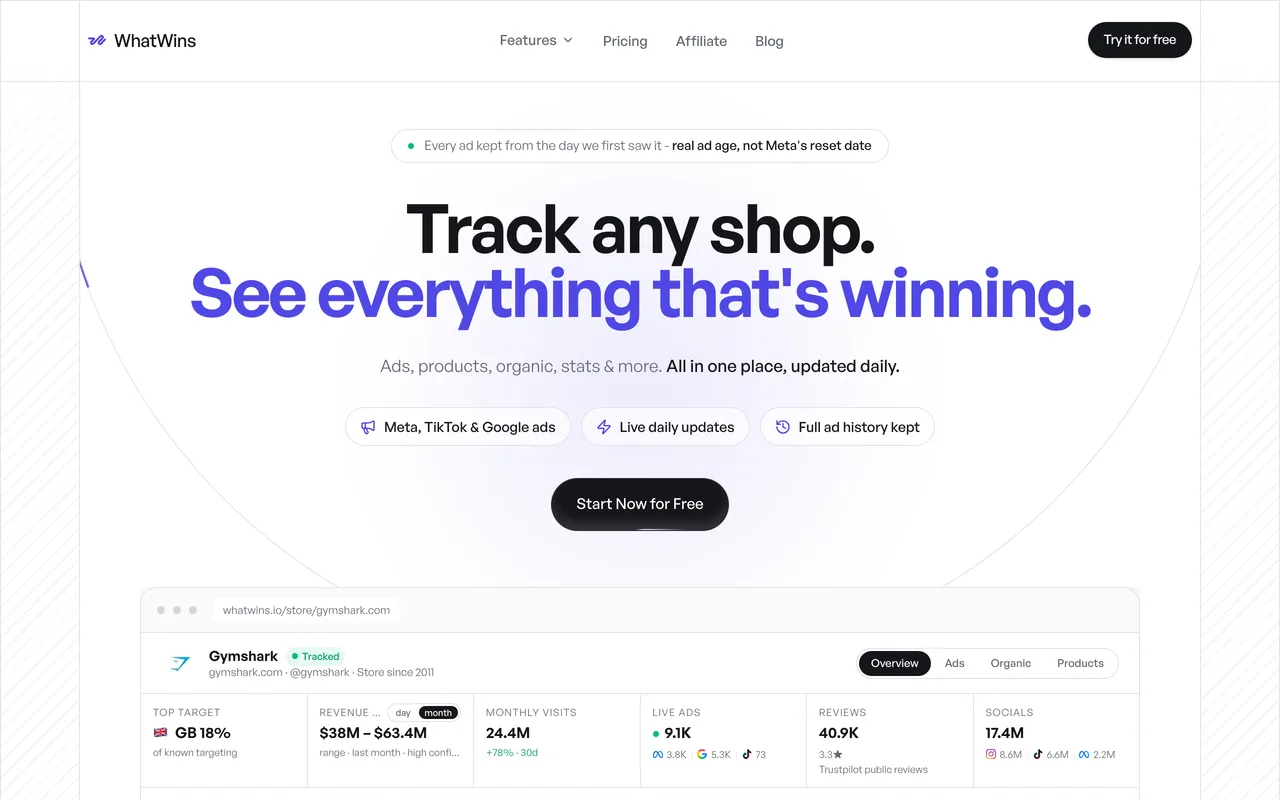
WhatWins combines two things most tools keep separate: ad-spy across Meta and TikTok, and organic viral intelligence on Instagram, TikTok, and YouTube. The idea is a simple loop — Track → Analyze → Reproduce → Grow, and product research lives at the front of it.
On the paid side, you search competitor ads in the ad library and track specific advertisers over time. Ad longevity is treated as a first-class signal: when an ad has been running for weeks, that's a strong indication it's profitable, and the product attached to it is worth a closer look. That single heuristic, long-running ad equals validated product, is the backbone of fast, low-risk product research.
Where WhatWins separates itself is the Shop Tracker. Instead of stopping at the ad, it lets you track competitor stores and see their traffic, ad activity, landing-page paths and estimated spend. So you don't just find a winning ad, you find the store behind it, the other products it sells, how the offer is framed, and how aggressively it's scaling. The Discovery view goes wider, surfacing ads, advertisers, and products you weren't already watching, and the viral reel radar with breakout alerts scores organic posts against each account's own baseline, so a post that's overperforming for that creator gets flagged even if it isn't globally huge. That catches demand before it hits the paid ad libraries.
Round it out with a swipe library to save creatives, trackable links and link-in-bio for measuring what you reproduce, and a team workspace with unlimited seats (no per-seat pricing).
Strengths: ads and organic in one place; Shop Tracker reveals the store, product and offer path behind a winning ad; breakout alerts catch demand early; long-running-ad signal makes validation fast; unlimited team seats.
Limitations: it's broader than a single-platform spy tool, so if you only want, say, a raw TikTok ad feed, a specialist may feel more focused. It's a newer entrant than some legacy databases.
Pricing: $39, $79, and $149/mo tiers, with a free trial. See pricing for what's in each.
See the broader product in the product research tool, the Shopify store spy workflow, the ad library, the Shop Tracker, or the direct WhatWins vs Minea comparison.
2. Minea
Best for: Dropshippers who want a broad ad-spy database with a product-discovery layer on top.
Minea is a well-known ad-spy and product research platform covering Facebook, TikTok, and Pinterest ads, with a "winning products" feed and influencer tracking. It's a solid all-rounder that many beginners start with because the interface is approachable and the product feed is curated.
Strengths: multi-platform ad coverage; curated winning-products feed; influencer/organic angle; beginner-friendly.
Limitations: the curated feed can lag behind the fastest movers, and deeper plans get pricey. It surfaces ads and products well but does less to reveal the store economics behind them.
If you're weighing it specifically, we cover Minea alternatives and the direct WhatWins vs Minea comparison in detail.
3. Sell The Trend
Best for: Dropshippers who want product discovery and store/supplier tooling bundled together.
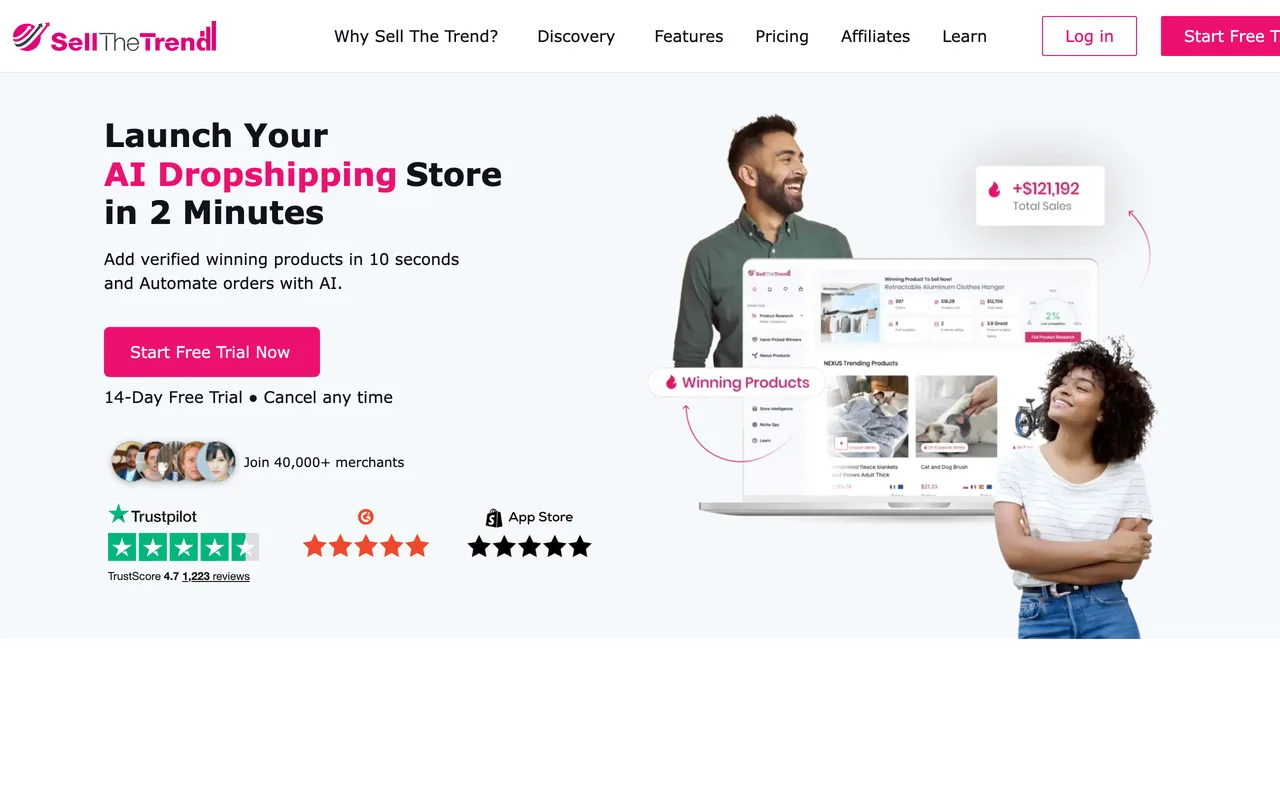
Sell The Trend leans into AI-driven product discovery, pulling trending products across stores and marketplaces and connecting them to suppliers. It's positioned as an all-in-one for dropshippers, with research, store analysis, and fulfillment-adjacent features under one roof.
Strengths: broad product discovery; supplier connections; engagement and trend metrics; all-in-one for dropshipping.
Limitations: because it's so broad, individual modules can feel shallower than a dedicated tool. Ad-spy depth is not its core strength compared with a pure ad library.
4. PiPiADS
Best for: Sellers focused primarily on TikTok ads.
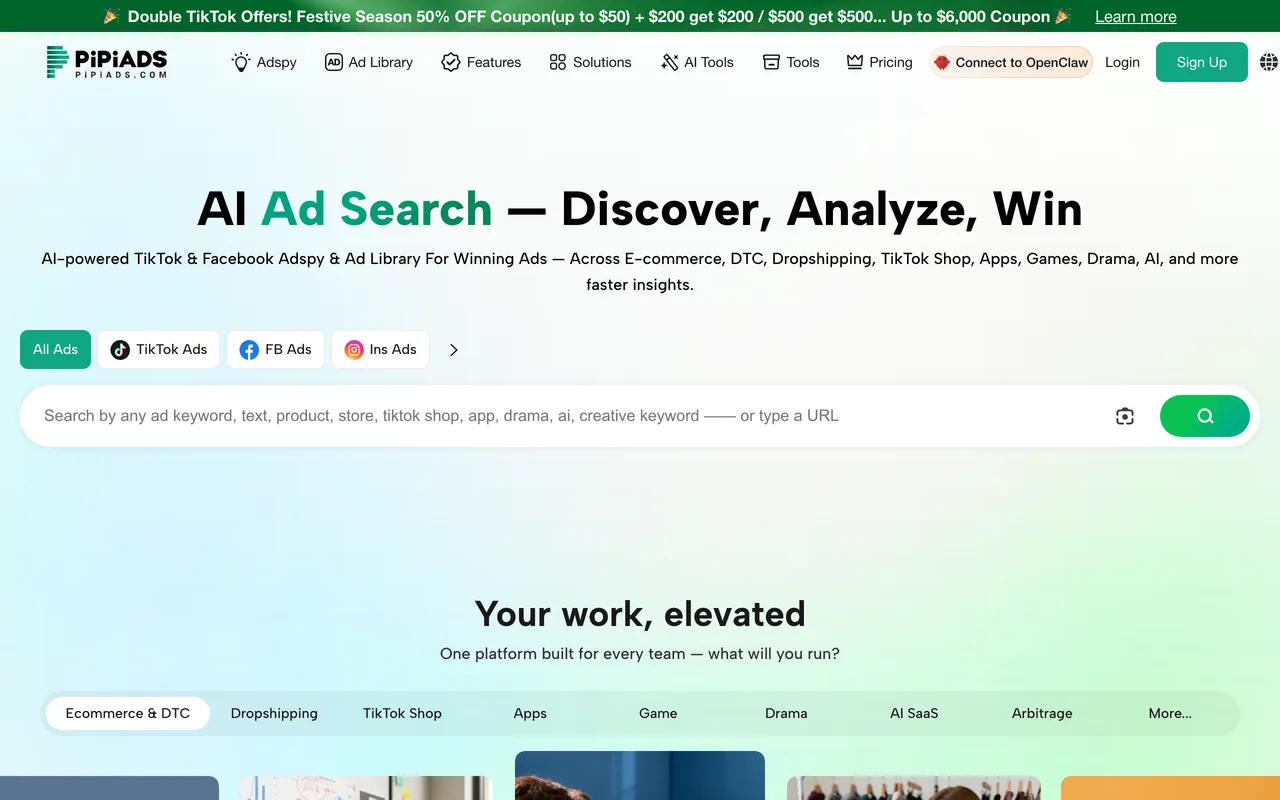
PiPiADS built its reputation as a TikTok-first ad-spy tool, with a large library of TikTok ad creatives, filtering by metrics, and product pages tied to the ads. If TikTok is your primary acquisition channel, its depth there is hard to ignore.
Strengths: deep TikTok ad coverage; strong filtering; product detail tied to creatives; useful for spotting TikTok-native winners early.
Limitations: Meta coverage is secondary, so you'll miss Facebook/Instagram-led products. Like most ad libraries, it shows you the ad but not the full store picture behind it. Our best TikTok ad spy tools roundup goes deeper on this category.
5. Dropispy
Best for: Budget-conscious sellers who want a large Facebook ad database.
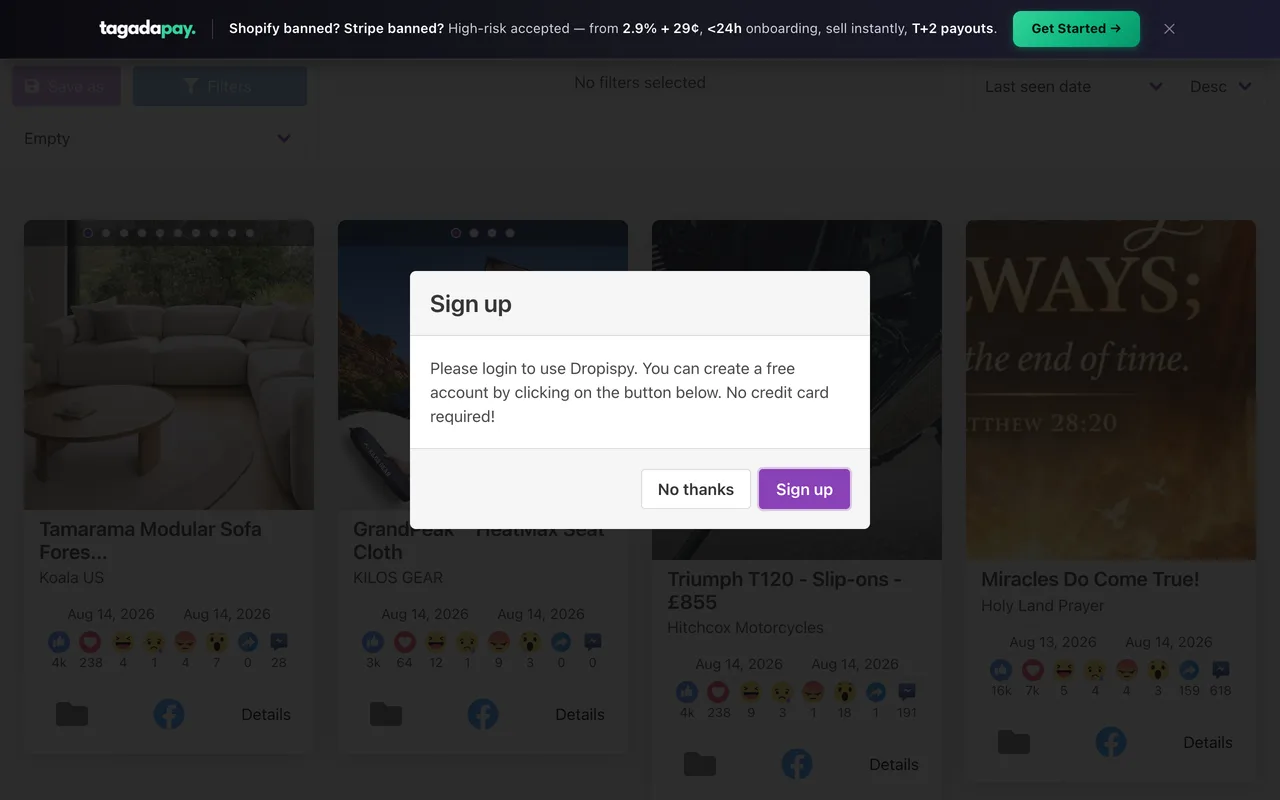
Dropispy is a Facebook-focused ad-spy tool with a very large ad database and a generous free tier, which makes it popular as an entry point. You can filter ads, find ecommerce creatives, and identify products being pushed at scale.
Strengths: big Facebook ad library; usable free tier; affordable paid plans; good for high-volume browsing.
Limitations: primarily Facebook-centric, so TikTok and organic discovery are weaker. The interface and data depth are more basic than premium tools, and there's limited store-level intelligence.
6. AdSpy
Best for: Power users who want the largest searchable Facebook + Instagram ad database with deep filters.
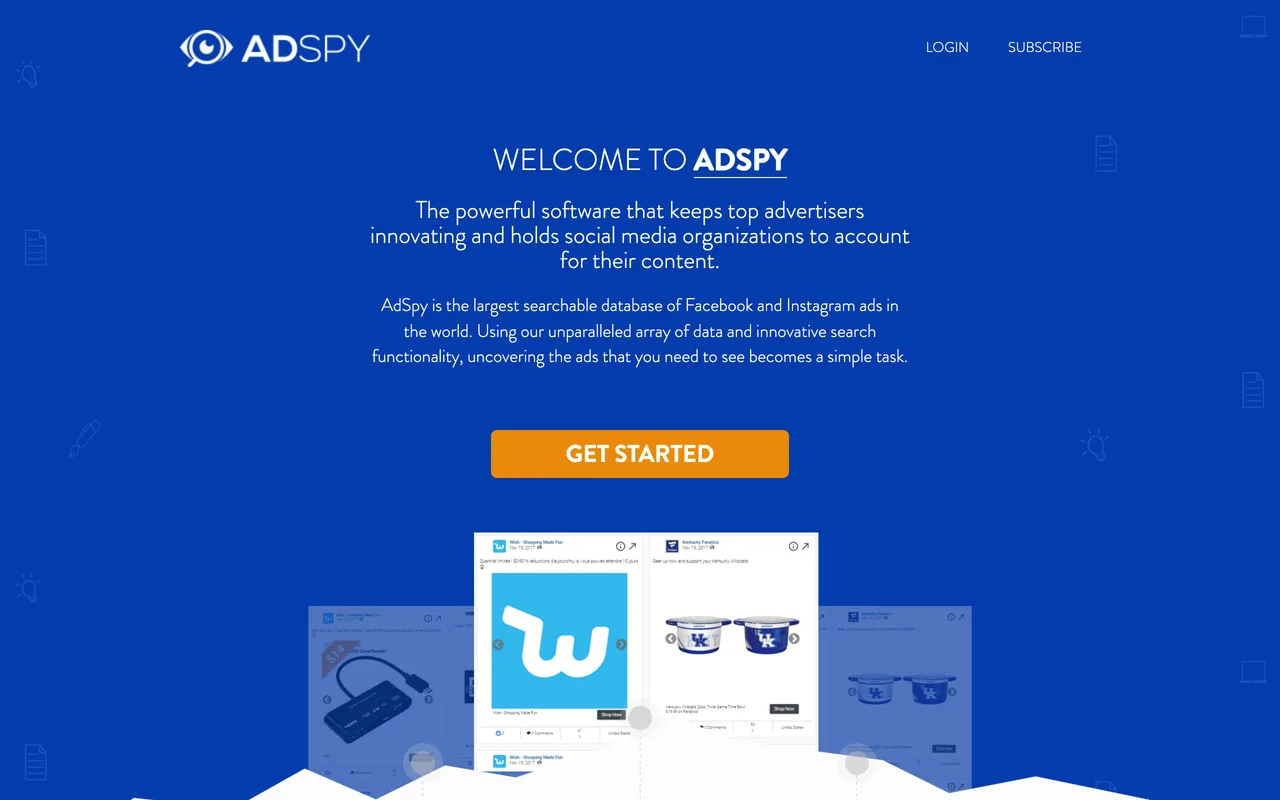
AdSpy is one of the oldest and largest ad-spy databases, with very granular search — by text, advertiser, demographics, engagement, and more. For sheer searchable volume on Meta, it's a heavyweight that serious media buyers still rely on.
Strengths: massive Meta ad database; extremely granular filtering; long track record; good for finding niche or older winners.
Limitations: single flat price that's high for beginners; UI feels dated; TikTok and organic coverage are limited. It's an ad search engine, not a full research suite. See our AdSpy alternatives breakdown if the price or scope doesn't fit.
7. Peeksta
Best for: Dropshippers who want ad-spy plus a curated winning-products feed at a friendly price.
Peeksta pairs a Facebook ad-spy database with a daily winning-products section and store/competitor tools. It's positioned as an affordable all-rounder, and the curated product feed is a nice on-ramp for people who don't want to start from a blank search.
Strengths: affordable; curated daily products; competitor store tools; approachable for newer sellers.
Limitations: ad database breadth and freshness trail the largest players, and organic/TikTok depth is limited. Curated feeds, by nature, mean you're seeing products others are also seeing.
8. EcomHunt
Best for: Beginners who want a hand-picked daily product list with context.
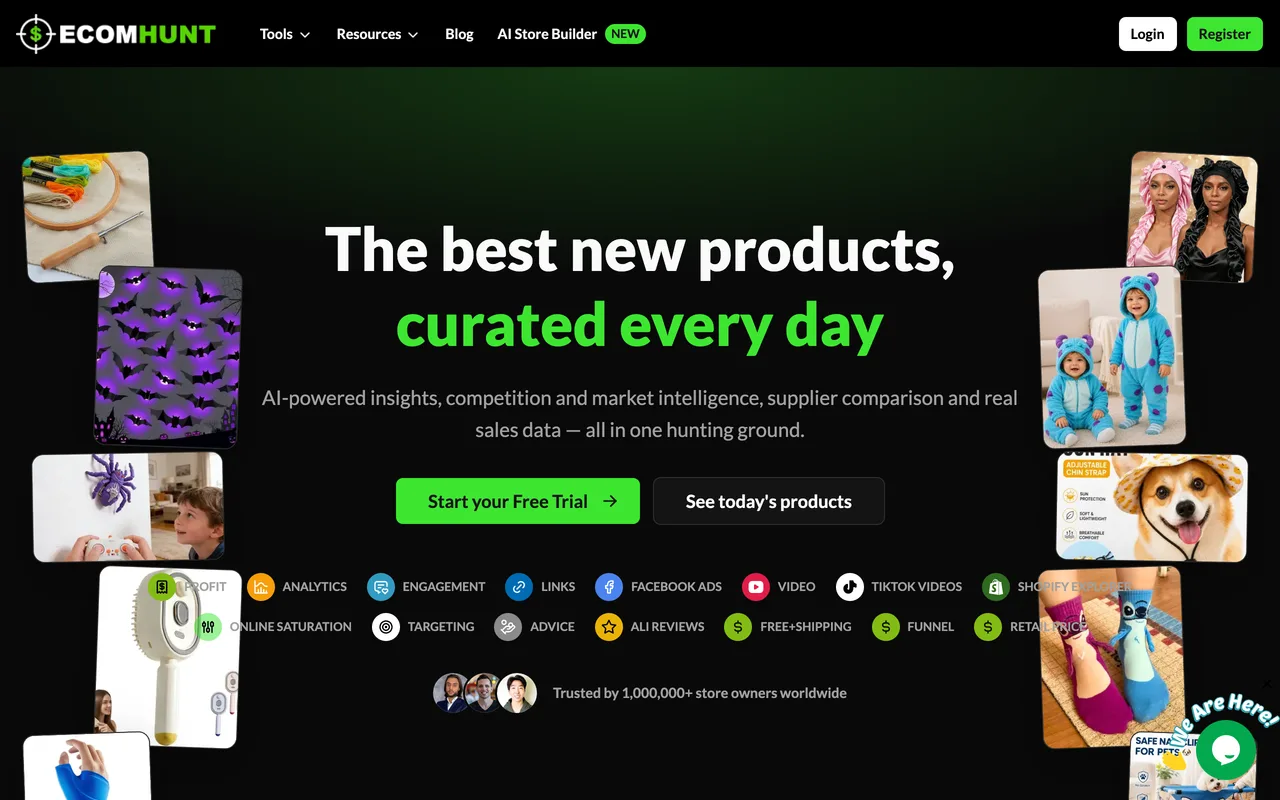
EcomHunt is one of the original curated product-discovery tools. Each day it publishes a small set of hand-picked products with profit margins, targeting ideas, ad examples, and supplier links. It's less a database and more an editorial product feed.
Strengths: curated and beginner-friendly; each product comes with context (margins, targeting, links); cheap; great for learning what a "good product" looks like.
Limitations: curation means low volume and high competition on featured products — everyone subscribing sees the same list. It's a starting point, not a research engine, and it doesn't reveal live store or ad-spend data.
9. Shophunter
Best for: Sellers who want to estimate the sales and revenue of specific Shopify stores.
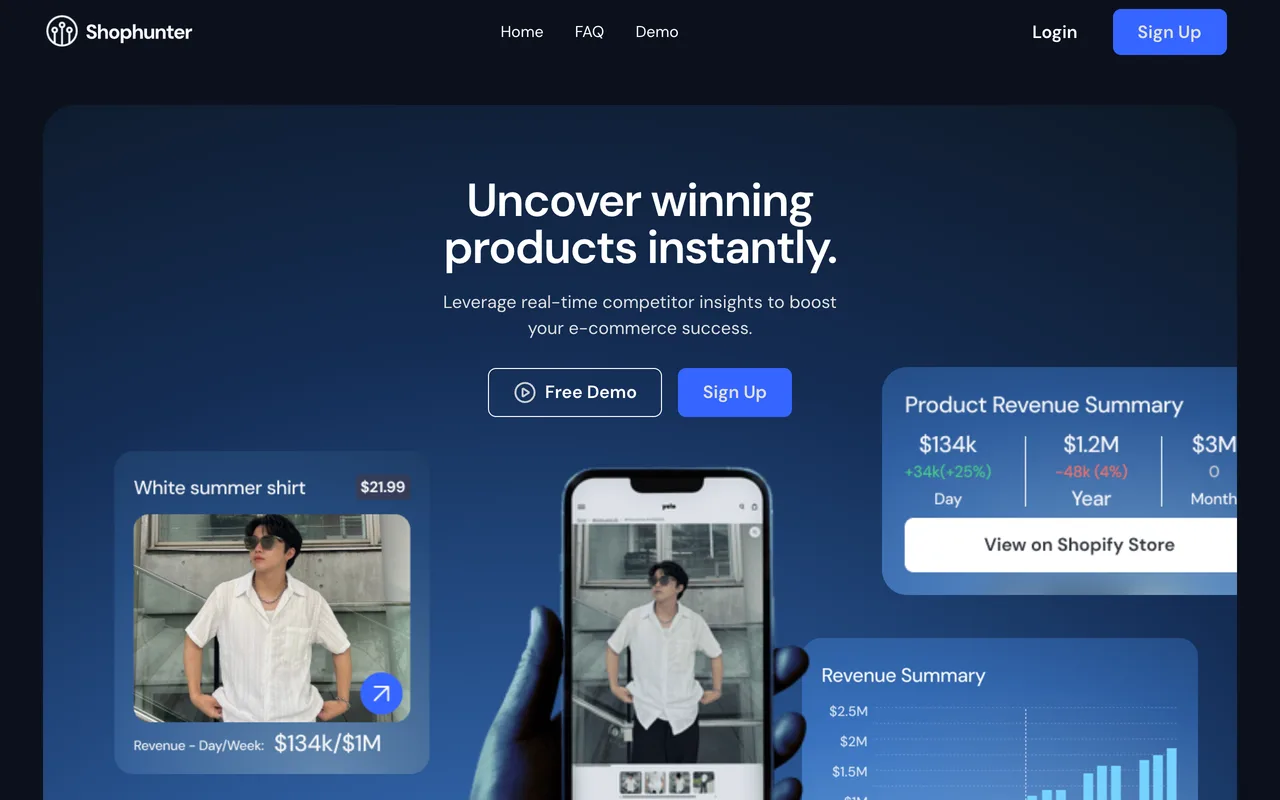
Shophunter focuses on store-level intelligence — estimating a store's sales, revenue, and best-selling products by tracking Shopify signals over time. Instead of starting from an ad, you start from a store you already suspect is winning and quantify it.
Strengths: store revenue and sales estimates; best-seller tracking; useful for validating that a store (and its hero product) is actually scaling.
Limitations: it's store-analytics-first, so it's not an ad library or organic-discovery tool on its own. You typically pair it with an ad-spy tool to cover the full loop. (WhatWins folds this kind of store intelligence into its Shop Tracker, which is why it can sit at the front of the list.)
Bonus: Koala Inspector
Best for: Anyone who wants a free browser extension to inspect a single Shopify store.
Koala Inspector is a Chrome extension that reveals a Shopify store's apps, theme, product feed, and best-sellers as you browse. It won't build you a research pipeline, but for one-off competitor teardowns it's a handy, free addition to any stack.
Strengths: free; instant per-store insight; reveals apps, theme, and product ordering; great for spot-checking a competitor.
Limitations: single-store, manual, and browser-only, no database, alerts, or ad data. It's a complement, not a core tool.
Comparison table
| Tool | Ad-spy (Meta) | TikTok ads | Organic / viral | Store-level data | Best for | Starting price |
|---|---|---|---|---|---|---|
| WhatWins | Yes | Yes | Yes (breakout alerts) | Yes (Shop Tracker) | Proven products + the store behind them | $39/mo |
| Minea | Yes | Yes | Influencers | Limited | Broad all-rounder | Paid plans |
| Sell The Trend | Limited | Limited | Limited | Some | Dropship all-in-one | Paid plans |
| PiPiADS | Secondary | Yes (deep) | No | Limited | TikTok-first sellers | Paid plans |
| Dropispy | Yes (large) | Limited | No | Limited | Budget FB browsing | Free + paid |
| AdSpy | Yes (largest) | Limited | No | No | Granular Meta search | High flat price |
| Peeksta | Yes | Limited | No | Some | Affordable all-rounder | Low paid |
| EcomHunt | Examples only | No | No | No | Curated daily picks | Low paid |
| Shophunter | No | No | No | Yes (revenue est.) | Store revenue estimates | Paid plans |
Pricing and coverage shift often; check each vendor for current details. WhatWins pricing is listed on the pricing page.
How to actually use these tools together
No single tool is a magic button, but the workflow is consistent regardless of which you choose:
- Find proof. Search ad libraries for long-running ads, an ad alive for weeks is a profitability signal. In WhatWins, sort and filter by longevity and let breakout alerts flag organic posts that are overperforming their account baseline.
- Verify the store. Once you spot a winning ad, look at the store behind it. WhatWins' Shop Tracker (or a store tool like Shophunter) tells you whether that store is actually scaling, what else it sells, and roughly how much it's spending.
- Swipe and shortlist. Save every promising creative and product to a swipe library so your shortlist is evidence-backed, not vibes-backed.
- Build and measure. Launch your store or product page, drive traffic with trackable links, and watch the numbers. If it works, double down; if it doesn't, your shortlist already has the next candidate.
If you want to go deeper on the spying half of this, our guides on how to spy on competitors' Facebook ads and how to find viral TikTok content pair well with this list. And once you've found products, How to Find Winning Products in 2026 walks through the full validation method step by step.
Frequently asked questions
What is the best product research tool for ecommerce in 2026?
The best tool is the one that proves demand rather than just inspiring ideas. WhatWins leads because it combines Meta and TikTok ad-spy with organic viral tracking and a Shop Tracker that reveals the stores and products behind winning ads. Minea, PiPiADS, and AdSpy are strong choices if you want a single-purpose ad database instead. See the dedicated product research tool page for the workflow.
Are free product research tools good enough?
Free tools like the Facebook Ad Library, TikTok's Creative Center, and the Koala Inspector extension are genuinely useful and worth using. They're slower and more manual, though, you do the filtering, tracking, and store analysis by hand. A paid tool earns its cost by automating that work and adding signals (ad longevity, breakout alerts, spend estimates) free sources don't expose.
How do I know a product is actually winning?
Look for converging proof: an ad that has been running for weeks (a profitability signal), the same product appearing across multiple scaling stores, and organic posts breaking out past their creator's normal reach. One signal is interesting; three together is a strong case. Tools that surface ad longevity and store growth make this far faster to confirm.
Do I need ad-spy and organic tracking, or just one?
You want both. Paid ads show what brands are pushing with budget; organic viral posts show what people actually want to share. Watching only ads means you find products after competitors have already paid to validate them. Watching organic breakouts lets you catch demand earlier. WhatWins combines the two so you don't have to run separate tools.
How much should I spend on a product research tool?
Most serious tools land between roughly $30 and $150 a month. WhatWins starts at $39/mo with a free trial, so you can validate the workflow before committing. The real question isn't the subscription, it's the cost of launching a product nobody wanted, which a good tool helps you avoid entirely.
Start finding proven products
The fastest way to de-risk your next launch is to research products that are already winning, and to see the stores selling them. WhatWins puts ad-spy, organic breakout alerts, and Shop Tracker in one place so your shortlist is built on proof. Start with the product research tool, or test the full workflow with a free trial.
Start a free trial or compare plans on the pricing page.